A year of an AI app builder costs $192 to $2,400. Here is the $99 route.

OpenCode is open source and lists more than a dozen free models today. Open the kit in it and the AI bill is $0.
The sum: a \(99 OTF kit once + a free model at \)0 = \(99 for the year, plus your hosting. Free models change; OpenCode calls them free for a limited time. Some listed models have a provider-stated zero-retention policy; check the current model terms before sending private code. If you already pay for Claude Pro, it is a flat \)20 a month: \(99 + (\)20 × 12) = $339 in year one, plus hosting.
| Setup | Kit + AI for 12 months | Hosting |
|---|---|---|
| OTF kit + OpenCode model listed as free today | \(99 + (\)0 × 12) = $99 | You choose and pay for it |
| OTF kit + Claude Pro monthly | \(99 + (\)20 × 12) = $339 | You choose and pay for it |

That free-model route is the headline case. For context, the cheapest builder plans below list at $20 to $30 monthly, or $240 to $360 over 12 months at monthly billing. The Claude Pro route lands around the same range. Compare the actual plan, credits and code workflow; hosting and extra usage can change a bill.
The meter is part of the workflow
A monthly plan usually gives a recurring allowance, but the unit and the work it covers differ by provider. The quoted plan prices below are checked on 13 October 2026. They are list prices before tax and do not include extra usage.
Bolt Pro is $25 per month and starts at 10 million tokens per month. Bolt says unused tokens roll over for one additional month. That is $25 × 12 = $300 across a year before any extra tokens; Bolt does not state an extra-token price on its pricing page. Bolt’s pricing page
v0 Plus is $30 per user monthly, including “$30 of included monthly credits per user.” Its page says users can “Purchase additional credits outside of your monthly usage.” That makes the floor \(30 × 12 = \)360 per user; it is not a ceiling if the included balance does not cover the work. v0 pricing
Replit Core lists at $20 monthly, or $18 per month when billed annually. Monthly billing gives a \(20 × 12 = \)240 year; annual billing is \(18 × 12 = \)216, paid upfront. Replit describes its pricing as “effort-based pricing based on request complexity” and says credits cover Agent and cloud services such as published apps, storage and databases. Replit pricing · Replit billing docs
Base44 Starter is $20 monthly, or $16 per month on annual billing. That is \(240 month-to-month across a year or \)192 billed annually. The vendor says credits are a monthly allowance for AI messages and integration actions, with exact use varying by action and model. Base44 pricing
| Plan | List price, 13 Oct 2026 | Twelve-month plan math |
|---|---|---|
| Bolt Pro | $25/month | \(25 × 12 = \)300 |
| v0 Plus | $30/user/month | \(30 × 12 = \)360/user |
| Replit Core | \(20/month; \)18/month annual-billed | \(240 monthly-billed; \)216 annual-billed |
| Base44 Starter | \(20/month; \)16/month annual-billed | \(240 monthly-billed; \)192 annual-billed |
| Replit Pro, v0 Business, Base44 Pro | $100/month (v0 per user) | \(100 × 12 = \)1,200 |
| Base44 Elite | $200/month | \(200 × 12 = \)2,400 |
These are plan totals only. Extra credits and usage charges are not included. A year on a higher plan can pass $1,000; $1,200 applies to named $100 tiers, and $2,400 to Base44 Elite. “AI builders cost thousands” is not a fair general claim: the cheapest annual totals here are $192 to $360, depending on billing and plan.
Lovable’s captured prices were in euros, not US dollars: Pro is €25 monthly and Business €50. Its FAQ says, “Default Mode: credits vary based on task complexity,” and says extra top-up prices are not stated on the page. Lovable also says buyers own their code and can sync or export to GitHub. This comparison is about the meter and where the code starts, not a claim that competitors lock code. Lovable pricing · Lovable GitHub docs
The code-first total
OTF’s kit costs $99 once, or $149 for the bundle. The individual kit licence includes one developer seat and 12 months of updates. After checkout, use the license email’s link to provide your GitHub username and claim the invite to the private source repo. You control that repo and choose the host. Your AI tool and hosting are separate costs. OTF pricing

Claude Pro is $20 monthly, or $200 billed upfront annually, and includes Claude Code. Its usage limits apply. Claude Code defaults to Opus 5.5, with Sonnet 5.5 and Haiku 5.5 available. Claude pricing · Claude Code model configuration
Here is the honest comparison: $339 for the kit plus monthly Claude Pro is within the $192–\(360 first-year range of the cheapest paid builder plans above. It is not cheaper than every entry plan. If you use an OpenCode model listed as free today, the kit and model total \)99 for year one. OpenCode says free model access is “for a limited time,” so do not treat $0 as guaranteed forever. Either total is before hosting.
We tested this ourselves on 13 October 2026. OpenCode 1.19.0, on a free model with no API key, read the SaaS Dashboard kit’s AGENTS.md and then followed one of the kit’s shipped task prompts: it added a new Reports page across three files in about 80 seconds. The recorded run used Space Bunny Free, which OpenCode lists as zero-retention. An earlier run on another free model stopped once with an error and finished on the rerun. We did not run the new page in the app, and one prompt on one kit is not a benchmark. The full write-up, including what we did not check, is on our OpenCode page. OpenCode model and pricing page · OpenCode rules docs
Owning the code is the point
The distinction is not “one platform owns your app and another lets you own it.” Lovable and Base44 both say users own their code, and their export or GitHub options are documented. For the OTF kit, the paid commercial licence delivers editable source into a private GitHub repo you control after the license-email claim step. The SDK underneath it is MIT-licensed open source; the kit itself is not an open-source or free kit.
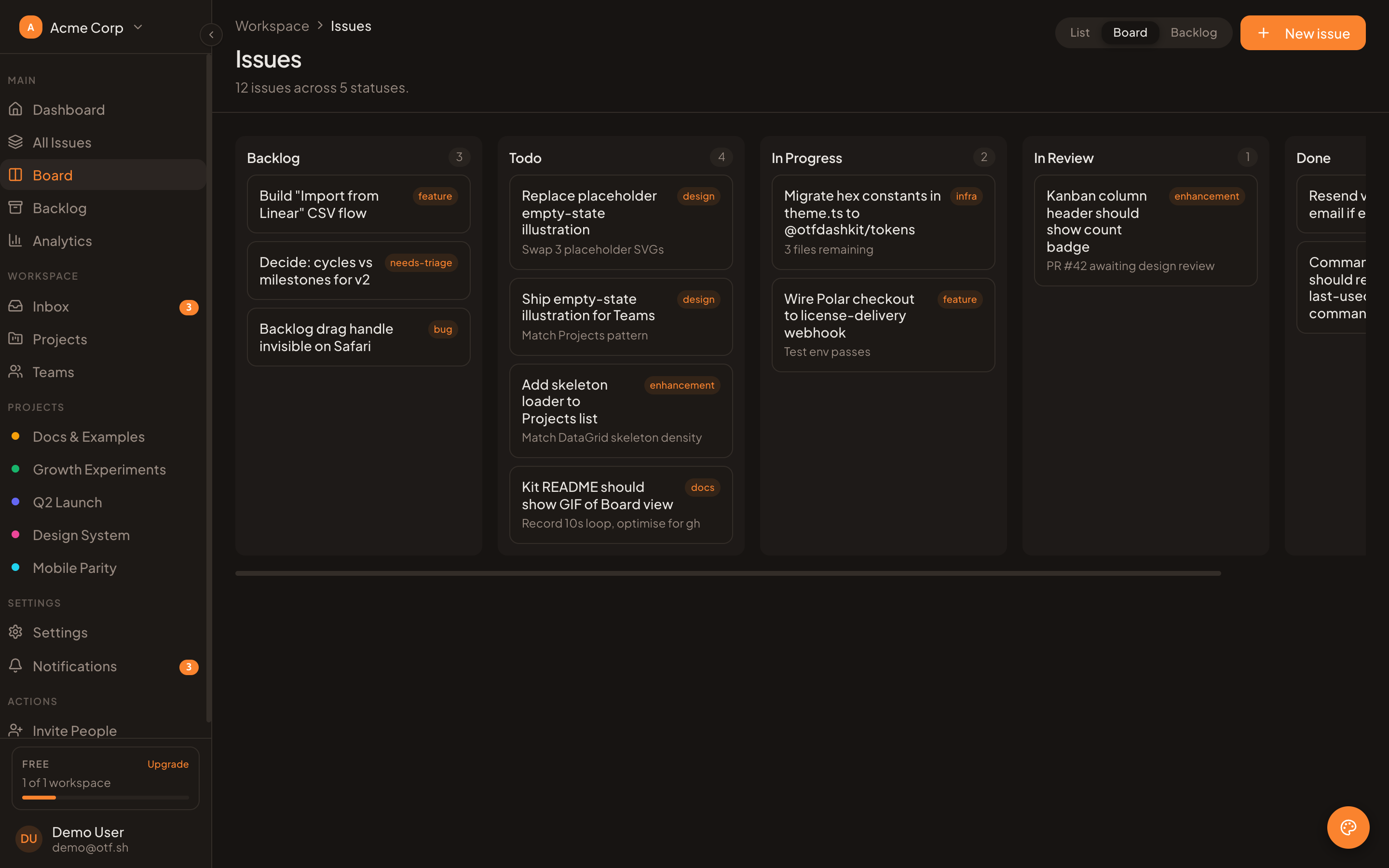
That changes what the recurring plan is buying. If you want to keep using a builder’s hosted editing workflow, its plan and credit allowance stay in the picture. With the kit, you can use an AI tool you already pay for, use a free model while it is available, or switch tools. You are choosing the model and the host rather than paying a kit meter for each prompt. You still have to test, maintain and run the app.
A practical caution belongs beside the free-model line. OpenCode says its free models are free for a limited time, and their data terms differ: some are listed as zero-retention, while at least one may use what you send to improve the model during its free period. That can be fine for an experiment and wrong for a client’s private code. Read the model’s terms before you send it anything you would not post in public.
For the code-export question, see what an export does and does not solve. Then compare the plan, credits, repo access, hosting and your actual year-one arithmetic. If you want to inspect the product before choosing a plan, start with OTF’s overview, then compare the SaaS Dashboard kit, Fitness kit, and Arcade kit pages. The case for paying once is straightforward: $99 buys the kit source under its licence, and the kit itself has no monthly credit meter. Your AI and hosting remain your choice and your bill.
Sources
Prices and product statements below were checked on 13 October 2026; list prices exclude tax.
- Bolt pricing — Pro list price, token allowance and rollover.
- v0 pricing — Plus and Business plans, included and additional credits.
- Replit pricing and billing documentation — Core/Pro pricing, usage billing and spend limits.
- Base44 pricing — monthly and annual plan prices and credit rules.
- Lovable pricing and GitHub integration docs — EUR list prices, credits, code ownership/export.
- OpenCode Zen pricing and rules docs — free model availability and
AGENTS.mdbehavior. - Claude pricing and Claude Code model configuration — Pro plan, Claude Code inclusion and model names.
- OTF kit pricing — kit and bundle price, source delivery, seat and update terms.
- OTF SDK repository — MIT licence.
Originally published at otf-kit.dev.